




The Japan Fair Trade Commission (JFTC) and the Cabinet Office’s Intellectual Property Strategy Headquarters unveiled fresh guidelines on June 22 to ensure equitable dealings for creators in anime and film production. As noted by Game Biz, these guidelines emphasize transparent contract details, reasonable remuneration, and proper cost distribution for supplementary tasks. This move is expected to tackle the numerous challenges between production firms and their subcontractors. Although this development appears beneficial for freelance anime creators, especially given the industry’s notorious working conditions and their lack of protection under existing labor laws, the JFTC’s initiative to promote these guidelines has encountered significant criticism.
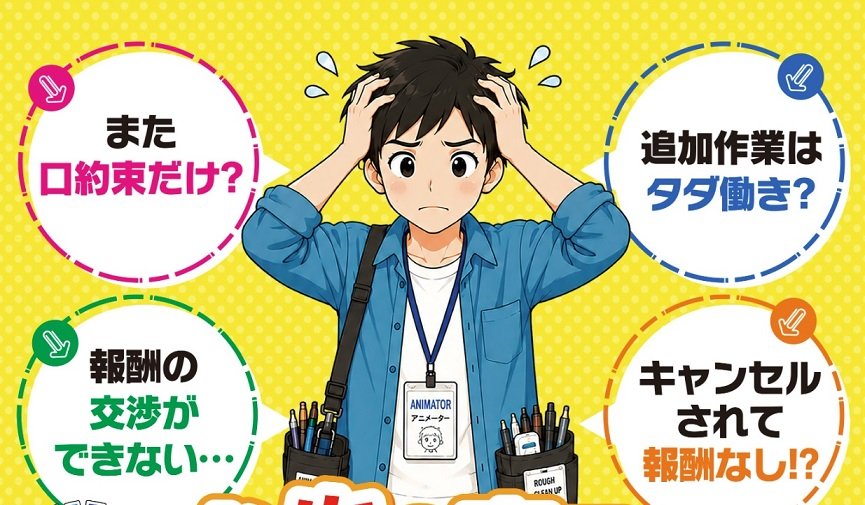
On the day of the announcement, the JFTC released informational brochures aimed at raising awareness about the new guidelines. However, the campaign faced sharp criticism from Japanese artists on X, as the brochures contained what seemed to be AI-generated illustrations. Many deemed the action “contradictory,” particularly because a government body supposedly published the brochures to assist independent creators without involving actual artists to produce the visuals. Moreover, the AI-generated images exhibited “disjointed” designs, including unrealistic portrayals of animator tools (such as upside-down drawing tablets, for instance), which only intensified the backlash.
The choice to use generative AI instead of hiring real creators to endorse policies like this really underscores why the Cool Japan strategy never fully succeeded.
These visuals truly demonstrate the “superior quality” of the Fair Trade Commission’s approach to anime production.
Why wasn’t an animator commissioned to create this?
Even though it’s meant to be a poster supporting creators, it’s absurd that they resorted to generative AI for it, lol. It’s clear these individuals don’t grasp the situation.
In reply to a query from Japanese news outlet ITMedia, the JFTC disclosed that the brochure was contracted to a specific production firm, but the actual work was carried out by an artist affiliated with a company subcontracted by that firm. It appears the artist utilized AI to generate images for the brochure, which were “subsequently refined for the final design.” According to the JFTC representative, the subcontractors confirmed that AI was employed to “enhance the efficiency of material creation.”
When commissioning the brochure, the JFTC did not forbid the use of generative AI in the contract terms. However, the production firm was obligated to verify that the materials produced did not violate any copyrights.
Regarding the design inconsistencies, the JFTC representative stated that although the Commission reviewed the final product, their examination primarily centered on industry business practices, and they lacked sufficient knowledge about the specifics like tools used on set.
The JFTC acknowledged the social media responses and indicated it plans to take suitable measures for future campaigns. However, it refused to comment on whether it would remove or replace the problematic visuals.
Related articles: