







We Love It’s Steam discovery platform, We Love It, released its Steam Revenue Report on August 20. Drawing on data from roughly 100,000 Steam titles, the report dissects revenue trends across various game genres. Notably, sandbox games emerged as a standout category, consistently yielding strong-selling titles.
It’s worth noting that the report’s revenue figures are derived from estimates rather than precise sales data. Researchers employed the Boxleiter method, which approximates revenue by factoring in the number of reviews, a multiplier, and the game’s price. The report offers three tiers of estimates: conservative (20x), standard (35x), and optimistic (50x). For this piece, we’ll focus on the standard 35x estimate.
Free-to-play games and titles no longer available for purchase, lacking a listed price, were excluded. Games with zero reviews were also left out, as reviews are essential for the calculation. Additionally, DLC was omitted, with the analysis confined to products labeled as “games” on Steam. Adult games were excluded, and fluctuations in pricing over time were not factored in.
The report encompasses approximately 100,000 games, with an estimated cumulative revenue of $129.8 billion USD. Among its findings, the genre-based revenue breakdown is particularly compelling. Genres are assigned based on whether they appear among a game’s top six most popular Steam tags. This approach allows a game to be counted in multiple genres—for instance, a roguelike FPS would contribute to both the roguelike and FPS category tallies.
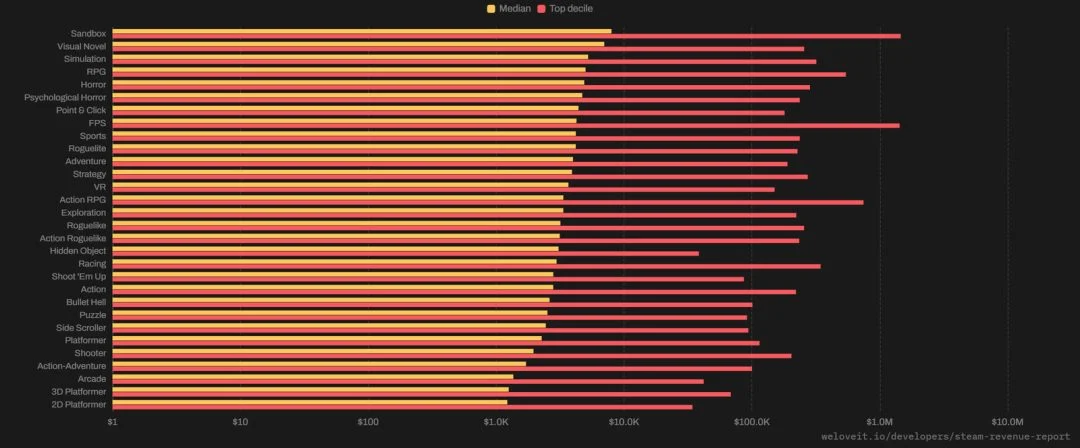
Image Credit: WeLoveIt.io
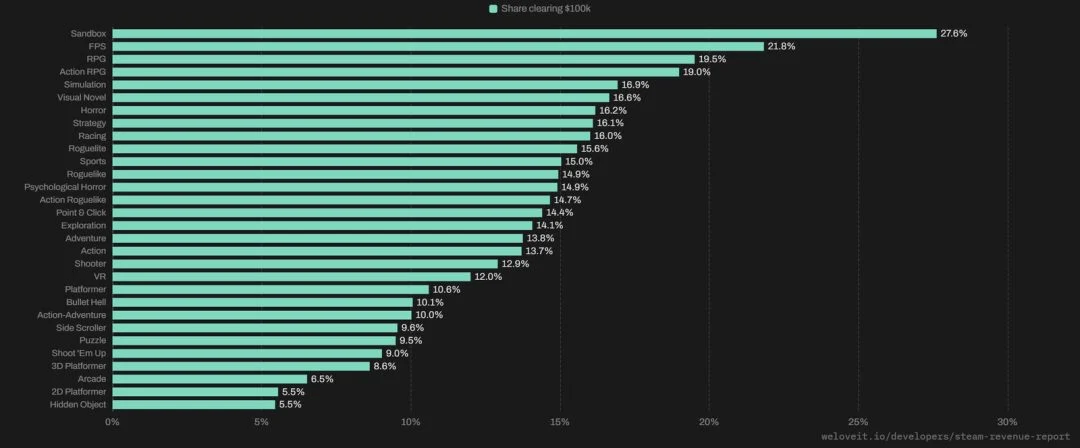
Image Credit: WeLoveIt.io
The report’s “Genre Economics” segment compares the median estimated revenue, top decile revenue, and “hit rate” (the proportion of titles earning at least $100,000 in estimated lifetime revenue) for 30 major genres. Among these, the sandbox genre shone brightest. It boasts both a high median revenue and top decile revenue, coupled with a notably high hit rate of 27.4%, positioning it as arguably Steam’s most reliably successful genre.
Genres with the next-highest median revenues included visual novels, simulation games, RPGs, horror, and point-and-click titles. In terms of top decile revenue, FPS games nearly matched sandbox titles, followed by action RPGs, RPGs, and racing games. This indicates that the genres yielding the biggest individual hits differ somewhat from those with the strongest median performance.
Conversely, platformer-related genres occupied the lower end of the spectrum. Despite including major releases like Sonic and Celeste, the report found that platformers generally generate comparatively modest revenue overall.
The report also explores the peak performance periods for different genres. In the “When Each Genre Peaked” analysis, each genre’s median estimated revenue is contrasted with the median revenue of all games. A value above 1 signifies that the genre outperformed the overall market that year, while a value below 1 indicates underperformance.
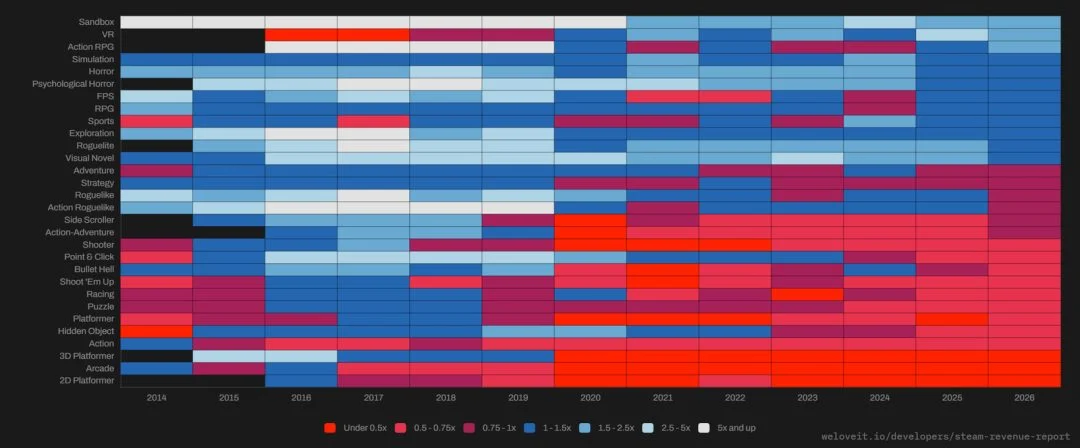
Image Credit: WeLoveIt.io
A notable trend here is that, since around 2020, fewer genres have achieved revenues exceeding five times the overall median. Concurrently, more genres have fallen below the overall median. The “Crowding vs. Payoff” analysis similarly suggests a gradual narrowing of the revenue gap between genres.
Sandbox games, in particular, dominated during the 2010s, with their median revenue in 2017 reaching approximately 15 times the overall market median. Roguelikes appear to have peaked around 2017, and while they remain successful, their recent revenue performance no longer surpasses the market average as significantly as it once did. Horror, visual novels, and RPGs have generally sustained slightly above-average revenue. FPS games have produced numerous highly successful titles overall, but the genre seems to have experienced a relative slump in the first half of the 2020s. Platformers have continued to struggle, especially since 2020, when their performance dropped markedly below the overall market median.
That said, the findings should be approached with caution, as the revenue figures are estimates, not actual sales data. The number of releases also varies widely between genres, meaning revenue may be distributed across a larger pool of titles in some categories. Nevertheless, the report offers an insightful overview of which genres tend to thrive on Steam and how their performance has evolved over time. Naturally, as the market evolves, the earning potential of different genres will likely shift as well. The report also delves into other factors, such as revenue by price range, potentially providing valuable insights for developers aiming to create commercially successful games.