






Japanese e-book distributor and publisher BookLive recently carried out a manga analysis using title and purchase data (source: GameBiz). The research explored how manga titles have evolved in terms of content and length over time, along with purchasing trends, the diversification of reading habits, and the connection between these factors.
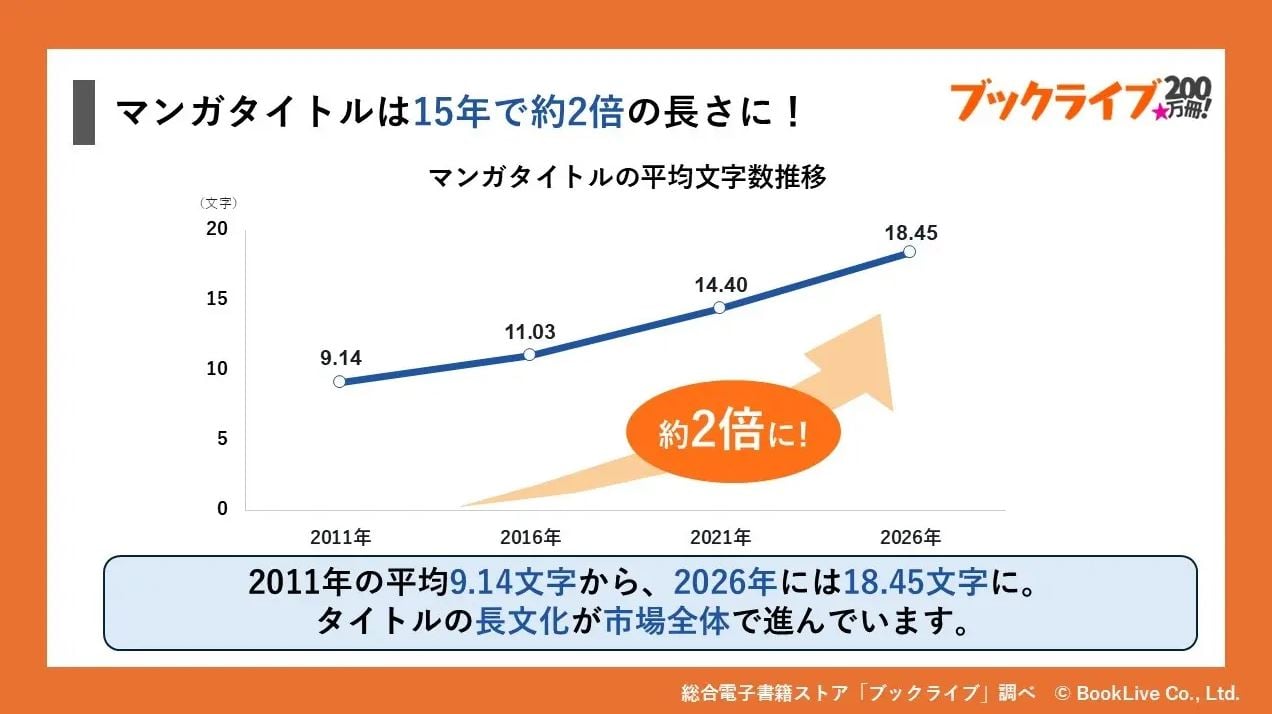
It was found that manga titles today are approximately two times longer than those from 15 years ago. Not only did the average number of Japanese characters in a manga’s first volume title surge from 9.14 in 2011 to 18.45 in 2026, but the median also grew from 8 to 16 characters during the same period. When categorized by target audience, current titles for male readers average about 17.11 characters, whereas those for female readers average 19.46 characters.
The shift toward lengthier titles was linked to a growing number of readers who prioritize time efficiency and cost-effectiveness. Longer titles tend to be more descriptive, reducing the likelihood that potential readers might feel disappointed with the content after purchasing. These “synopsis-style” titles, influenced by the popularity of web novels, now function as searchable tags within e-bookstore search engines.
The terminology used in manga titles has also evolved over time. Shonen and seinen works featuring terms like “alternate world/isekai,” “reincarnation,” and “strongest” in their names have frequently achieved bestseller status, alongside a rising tendency to highlight world-building and protagonist abilities in the title.
Shojo and women’s manga titles have undergone more significant changes. Manga titles containing romance-focused terms such as “love,” “marriage,” and “romance” were common in 2016, followed by realistic (sometimes labeled “drama-based”) titles with words like “housewife,” “exploitative workplace,” and “neighborhood” in 2019. Since 2021, isekai-related terms including “young lady,” “villain,” “doting love,” and “saint” have dominated BookLive’s top sellers list.
Regarding bestsellers, it was observed that many readers engage with titles beyond the top sellers list. BookLive’s top 100 best-selling titles accounted for only 15.3% of its total sales over the past year, with titles outside the top 100 making up roughly 85%. Additionally, 42.9% of readers did not buy any books from the top 100, indicating a majority shift toward non-bestsellers.
Bulk purchasing has also risen over time, with the average number of books bought per transaction climbing from 1.19 in 2011 to 2.82 in 2026. The average total purchase value also increased from 567 JPY ($ 3.60 USD) to 1,327 JPY ($ 8.43 USD). These trends were noted across various demographics, suggesting that e-books and promotional sales have encouraged buyers to acquire and read entire series at once.